
Bat Removal From Ohio Houses and the Pup-Season Timing
Bat removal from an Ohio house is timed around the weeks when the pups cannot fly yet, and an independent operator does the work.
Calls route by ZIP to an independent operator where one covers the address; where none does, they come to Local Core Group, which runs this site.
Note where the bats come out and where droppings collect, then call the number on this page. The U.S. Fish and Wildlife Service says little brown bats typically give birth in May or June and that the young can fly in about four weeks. An operator inspects and explains the plan on the call.
What should I do first about bats in the attic?
Note where the bats come out of the roofline and where droppings collect below. If a bat has been inside the living space, read the bat in the house page first. Then call the number on this page. Ohio Attic Animal Removal is a referral service: the request goes to an independent operator when one works at your address, which is settled on the call. The operator sets the price and answers for the state rules that apply to the work.
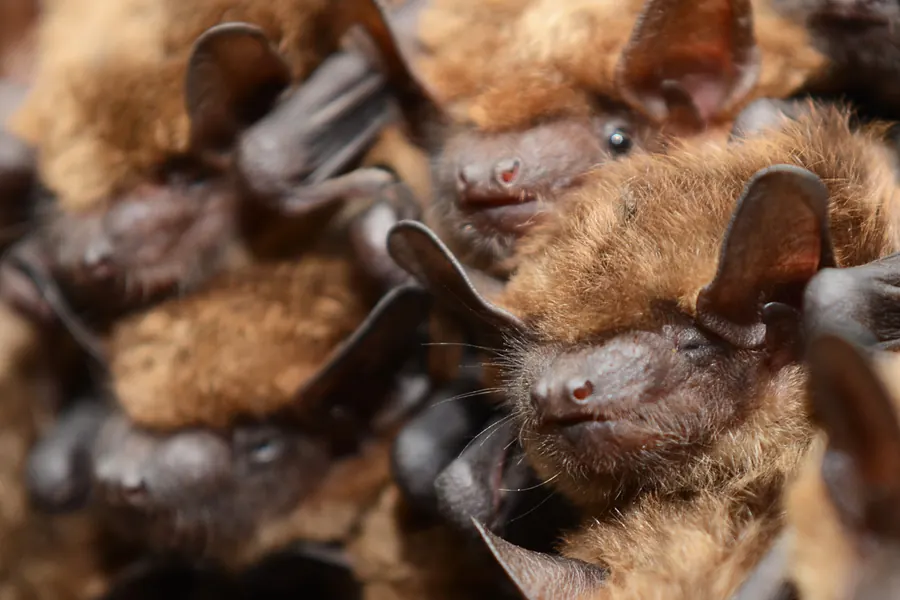
Is it a big brown or little brown bat colony?
An Ohio State University Extension article from 2016 says two Ohio bat species commonly share living space with people: the big brown bat and the little brown bat. The U.S. Fish and Wildlife Service says little brown bat maternity colonies commonly are in “warm sites in buildings, like attics” and other human structures.
You do not have to tell them apart. The operator identifies the species at the house, and it matters because of the federal listings further down this page.
What helps is where and when. Note the spot on the roofline the bats use, the time you see them, and where droppings pile up underneath.
One bat flying in a bedroom or a living room is a different problem from a colony overhead. The page for a single bat indoors covers that case.
How much of Ohio’s animal rabies is in bats?
Most of the confirmed cases. An Ohio State University Extension fact sheet dated January 3, 2022 reports 225 confirmed animal rabies cases in Ohio from 2016 to 2021. It says those cases included 194 bats and 29 raccoons, plus one cat and one fox.
That count says which animals the confirmed cases were. It does not say what share of bats carry rabies.
Questions about contact with a bat go to a health department, not to an operator. The locations page lists who takes bat contact calls in the cities and counties it covers.
Who handles the bats once a colony is found?
Two different parties. A health department deals with exposure questions and rabies testing. The work on the building is done by an independent operator.
Ohio Attic Animal Removal is neither. It is a referral service run by Local Core Group, with no field staff. A call to the number on this page is passed to an independent operator when one works at your address, and whether one does is settled on the call. The operator sets the price and answers for its own license and insurance.
When in the year can a bat colony leave an Ohio house?
The calendar below comes from the U.S. Fish and Wildlife Service and from Ohio State University Extension.
| Time of year | What the bats are doing | Source |
|---|---|---|
| March through September | The active season for bats in Ohio | Ohio State University Extension article, 2016 |
| May and June | Young are born. Little brown bat females typically have a single pup | U.S. Fish and Wildlife Service; Ohio State University Extension slides, 2022 |
| About four weeks after birth | Little brown bat young are able to fly | U.S. Fish and Wildlife Service |
| July and August | Pups are out foraging | Ohio State University Extension slides, 2022 |
| October through March | Bats migrate and hibernate | Ohio State University Extension slides, 2022 |
The 2016 Extension article says that if exclusion happens before the young can fly, the mothers are shut out and the young are left inside to die.
State rules apply to bat work. This page does not restate them, and the operator who takes the job answers for them.
What does shutting a bat colony out involve?
An operator inspects the house and explains the plan on the call. The one method fact this page can source is about timing: the 2016 Ohio State University Extension article says exclusion before the young can fly shuts the mothers out and leaves the young inside to die.
Questions worth asking the operator who takes the job:
- Which gaps the bats are using, and how those were found.
- How the operator will know the young can fly.
- What will be closed, with what, and when.
Nothing on this page is a how-to.
Are the bats in my attic a protected species?
Under federal law it depends on the species. These are the U.S. Fish and Wildlife Service statuses as of November 2, 2026.
- Little brown bat: not federally listed. The Service says it is reviewing the species’ status.
- Northern long-eared bat: listed as threatened in 2015, then reclassified as endangered by a rule published November 30, 2022 that took effect March 31, 2023.
- Indiana bat: endangered, with a listing date of March 11, 1967.
- Tricolored bat: proposed for listing as endangered in September 2022, and still proposed, not listed.
Tricolored and northern long-eared bats mostly roost in trees, but not always. The Service says tricolored bats have been seen roosting in barns and beneath porch roofs, and that northern long-eared bats are found, less commonly, in structures such as barns and sheds.
State protections are separate from the federal listings. The operator who takes the job answers for both.
What should I tell the operator when I call?
Have these ready:
- Where droppings collect, inside or outside.
- Where on the roofline you have seen bats, and at what time.
- Whether a bat has been in the living space.
- The month you first noticed them.
No prices appear on this site. An operator explains the plan and the cost on the call.
Droppings are a separate piece of work. What it involves is covered under bat droppings cleanup.
Who to call in four Ohio cities
Each city page says which health department a resident calls about a bat or a bite, and what the city or county does and does not do about an animal in a house. They are information pages; none says an operator works there.
Questions and answers
How do you get rid of bats in the attic?
An operator inspects the house and explains the plan on the call. An Ohio State University Extension article from 2016 says that exclusion before the young can fly shuts the mothers out and leaves the young inside to die. This page gives no how-to steps.
When can bats be shut out of a house in Ohio?
The sources on this page describe the biology. The U.S. Fish and Wildlife Service says little brown bats typically give birth in May or June and that the young can fly in about four weeks. Ohio State University Extension slides from 2022 say bats migrate and hibernate from October through March. State rules apply to bat work, and the operator who takes the job answers for them.
Is it expensive to get rid of bats in the attic?
This site lists no prices. An operator explains the plan and the cost on the call.
Are the bats in my attic endangered?
It depends on the species. As of November 2, 2026 the Indiana bat and the northern long-eared bat are federally endangered, the tricolored bat is proposed for listing, and the little brown bat is not listed while the U.S. Fish and Wildlife Service studies its status. The operator identifies the species at the house.
What if one bat is flying around inside the house?
That is not a colony job. Read the page on a bat flying indoors before you do anything else.
Sources for this page
Each link opens the page a fact on this page came from, with the date it was read. Agency pages change; the date shows which version this site saw.
- Got Bats in the Belfry? Here’s What to Do! (July 13, 2016)Ohio State University Extension, Buckeye Yard & Garden onLine (Marne Titchenell)
- Little Brown Bat (Myotis lucifugus)U.S. Fish and Wildlife Service
- Rabies Prevention in Livestock (VME-0001, 01/03/2022)Ohio State University Extension, Ohioline (Timothy McDermott, DVM)
- Bats: What You Didn’t Learn Watching Batman (Oct 2022, PDF)Ohio State University Extension (Marne Titchenell), Master Gardener Volunteer webinar slides
- Indiana Bat (Myotis sodalis)U.S. Fish and Wildlife Service
- Northern Long-eared Bat (Myotis septentrionalis)U.S. Fish and Wildlife Service
- Tricolored Bat (Perimyotis subflavus)U.S. Fish and Wildlife Service
- ECOS species report export: ESA listing status and listing date for five speciesU.S. Fish and Wildlife Service (ECOS)
- Endangered Species Status for Northern Long-Eared Bat (87 FR 73488), document metadataU.S. Fish and Wildlife Service (Federal Register)
- NLEB endangered status; delay of effective date (88 FR 4908), document metadataU.S. Fish and Wildlife Service (Federal Register)
- Review of Species That Are Candidates for Listing (Candidate Notice of Review), Oct 31, 2025U.S. Fish and Wildlife Service (Federal Register)
How this page was checked
- Last checked
- , by Local Core Group, against the sources listed here
- How pages are made
- How this site’s pages are researched and written
- Sources
- Every source the site uses is on one page: all sources
This page is general information for Ohioans, not advice about one house. It was written from the sources listed and does not replace a health department or a doctor; state wildlife rules apply to any work on the house, and the operator who takes the job answers for them. Agency pages, phone numbers and procedures change, so check the linked source before you act on a detail.
Corrections. If a sentence here is wrong or out of date, name the page and the sentence in a message through the contact form or call 614-767-5459. An error that checks out against the source is corrected, and the date above changes with it.
Other pages that may fit
Bat in the House
A bat loose in a room: the exposure check first, then which health department to call and who captures the bat.
Bat in the house →Attic Insulation Removal and Cleanup
Soiled insulation, bat droppings, raccoon latrines and mouse nests: what health sources say, and what to ask an operator.
Attic cleanup →Animals in the Attic
Not sure what is up there. The season narrows the animal, with the Ohio source for each clue.
Animals in the attic →Animals in the Chimney
Scratching or chirping in the flue. Raccoons with young, protected chimney swifts, and what waits until the birds have gone.
Animals in the chimney →Call to be routed to an independent bat operator
Give the sound, the part of the house and your ZIP code. The request goes to an independent operator when one works at that address, and the two of you settle the visit and the price.